We are pleased to welcome you to the 2026 International Symposium on Frontiers in Molecular Ecology, which is scheduled to be held in Chengdu, Sichuan Province, from May 15 to 18, 2026. The symposium aims to strengthen international academic exchanges in the field of molecular ecology, discuss cutting-edge theories and technological advances in the discipline, explore innovative applications of emerging technologies such as genomics, multi-omics, molecular biology and artificial intelligence in ecological research, and promote interdisciplinary integration and collaborative development of this research area. We warmly invite experts and scholars from China and abroad to attend, exchange ideas, and actively participate in the symposium. Relevant details are provided below:
Hosts:
Sichuan University, Molecular Ecology
Organizers
College of Life Sciences, Sichuan University; Key Laboratory of Bio-Resources and Eco-Environment, Ministry of Education
Symposium Chairs
Loren Rieseberg, Ben Sibbett, Jianquan Liu, Kangshan Mao
Chair of the Organizing Committee
Jing Wang
Members of the Organizing Committee
Jing Li, Yongjie Wu, Tao Ma, Huanhuan Liu, Tao Li, Jialiang Li, Xiaoting Xu, Zhengyang Wang
I. Symposium Content
1. Invited Keynote Lecture
List of invited speakers (Continuously updated)
Loren Rieseberg Co-Editor-in-Chief, Molecular Ecology, The University of British Columbia, Canada
Maren Wellenreuther Editor-in-chief, Evolutionary Applications, The University of Auckland, New Zealand
Daniel Ortiz-Barrientos The University of Queensland, Australia
Suhua Shi Sun Yat-sen University, China
Jianquan Liu Lanzhou University, China
Yalong Guo The Chinese Academy of Sciences, China
...
2. Theme Report and Graduate Student Forum
The symposium focuses on research across the entire field of molecular ecology, including (but not limited to) the following themes:
·Ecological, evolutionary, and population genomics
·Population structure and phylogeography
·Landscape genomics
·Community ecology and coevolution
·Reproductive strategies and sex allocation
·Population genetic theory
·Analytical methods development
·Conservation genetics
·Speciation and hybridization
·Microbial biodiversity
·Molecular adaptation and environmental genomics
3. Editors Round-table Talks
Editors-in-Chief and editorial teams of authoritative journals in the field, including Molecular Ecology, Evolutionary Applications, Molecular Plant and Plant Communications will conduct in-depth exchanges with participants and jointly discuss the future development trends of the discipline.
4. Poster Presentation
The symposium provides 30 to 40 poster display booths. Please indicate whether you will present a poster when registering. Recommended poster size: 80 cm in width and 120 cm in height. Participants design posters independently, and the conference secretariat will print them uniformly. Please send the poster design draft to the designated conference email address (ISFME2026@163.com) before April 15.
5. Abstract Collection
All participants are welcome to submit abstracts. The abstract should be within 400 words, including objective, methods, results and discussion. Please send the abstract to the conference email address (ISFME2026@163.com) before April 15, 2026.
II. Symposium Time, Venue and Schedule
Time
May 15 to 18, 2026
Venue
Xiangyu Hotel, Chengdu (No. 103 Xinnan Road, Wuhou District, Chengdu City)
Schedule
·Afternoon of May 15: Check-in and Registration
·Evening of May 15: Editors Round-table Talk
·Morning of May 16: Opening & Keynote Sessions
·Afternoon of May 16: Theme Report & Graduate Student Forum
·Morning of May 17: Theme Report & Graduate Student Forum
·Afternoon of May 17: Plenary & Conclusion
·May 18: Departure
III. Registration and Payment
1. Registration
Please fill out the following registration form and send it to ISFME2026@163.com before April 30, 2026
Registration Fees: The symposium has adopted an advance registration system, with the payment time of the conference fee as the criterion, divided into three phases:
(1)Early Bird Registration: February 15 to March 31, 2026
(2)Regular Registration: April 1 to April 30, 2026
(3)On-site Registration: On-site payment from May 15, 2026 during the symposium
Registration Phase |
Fee Scale (EUR per person) |
Regular Participants |
Student Participants |
February 15 to March 31 |
500 |
350 |
April 1 to April 30 |
550 |
400 |
From May 1, 2026 during the symposium |
600 |
450 |
Fee Schedule (EUR per person)
Symposium Payment
Registration will be definite only after receipt of the payment.
Payment and conditions for cancellation Payment
Bank transfer: send a copy of your bank transfer by email to ISFME2026@163.com (See bank account details below).
Payment by bank transfer will not be possible after May 15, 2026.
Swift Code:ICBKCNBJSCN
Bank Name: INDUSTRIAL AND COMMERCIAL BANK OF CHINA SICHUAN BRANCH CHUNXI SUB-BRANCH
Bank Address: NO.35 ZONGFU ROAD JINJANG AVENUE CHENGDU CHINA
Beneficiary Account Name: Chengdu yuanliu wenhua chuanbo youxiangongsi
Beneficiary Account Number:4402 2090 2914 0048 413
Beneficiary Addres:Suite 331, Building 2, No. 432 Jinyang Road, Chengdu, Sichuan, China
Please include the note: ' Name + ISFME2026' with your remittancee
IV. Accommodation and Catering
1.Catering: Breakfast is provided by the accommodation hotel; lunch and dinner are uniformly arranged by the conference secretariat.
2.Accommodation: Accommodation fees are not included in the registration fee and must be covered by the participants. As room availability is limited during the peak tourist season, we strongly recommend making reservations in advance.
Reservation Hotline of Xiangyu Hotel, Chengdu (symposium hotel): 028-85551111-8122
Accommodation Rates: Twin Room: 420RMB per room per night; Single Room: 470RMB per room per night
If there are any issues with booking, please contact ISFME2026@163.com
V. Travel Routes to the Venue
No shuttle service is provided for this symposium; please travel to the venue by yourself. The travel routes are as follows:
1. From Chengdu East Railway Station to the Venue
(1) Rail Transit: Take Metro Line 2 (towards Xipu), transfer to Metro Line 3 (towards Shuangliu West Station) at Chunxilu Station, exit from Exit A of Moziqiao Station, and walk 50 meters to the hotel. The whole journey takes about 30 minutes.
(2) Taxi: Approximately 8.4 kilometers, taking about 25 minutes.
2. From Chengdu Shuangliu International Airport to the Venue
(1) Rail Transit: Take Metro Line 10 (towards Taipingyuan), transfer to Metro Line 3 (towards Chengdu Medical College) at Taipingyuan Station, exit from Exit A of Moziqiao Station, and walk 50 meters to the hotel. The whole journey takes about 40 minutes.
(2) Taxi: Approximately 17 kilometers, taking about 30 minutes.
3. From Chengdu Tianfu International Airport to the Venue
(1) Rail Transit: Take Metro Line 18 (towards South Railway Station), transfer to Metro Line 1 (towards Weijianian) at South Railway Station, then transfer to Metro Line 3 (towards Chengdu Medical College) at Provincial Gymnasium Station, exit from Exit A of Moziqiao Station, and walk 50 meters to the hotel. The whole journey takes about 70 minutes.
(2) Taxi: Approximately 60 kilometers, taking about 75 minutes.
VI. Conference Contacts and Contact Information
Conference Coordinator: Ms. Wang, jingwang368@126.com
Abstracts & Posters: Ms. Wang, wangzengscu@gmail.com
Registration & Payment: Ms. Huang, 496191582@qq.com (Symposium registration, accommodation, fee collection and invoice issuing)
Symposium Sponsorship: Mr. Zhou, zhou_xy2003@163.com
Sichuan University
February 10, 2016
About Chengdu
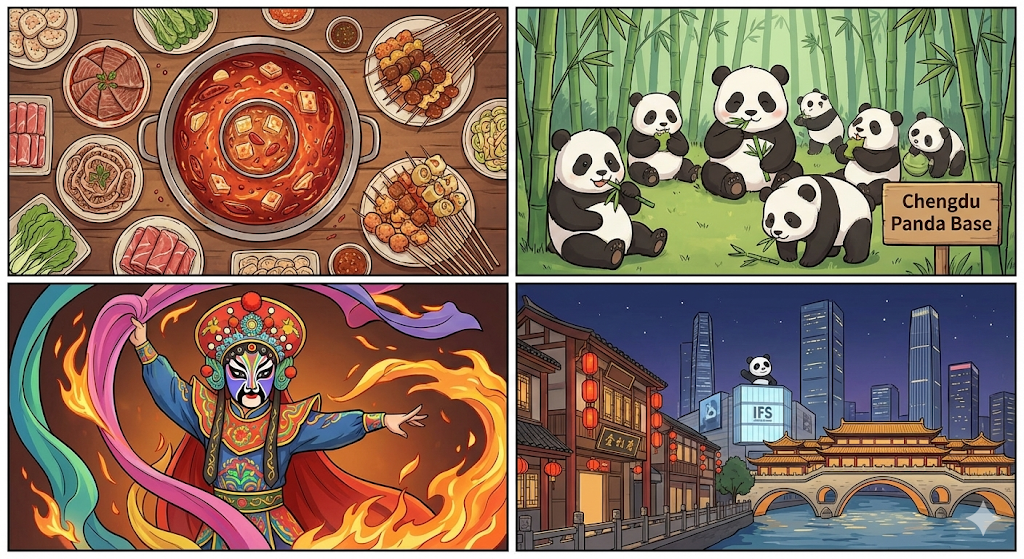
Chengdu, the capital of Sichuan Province, is celebrated as the "Land of Abundance"—a city where millennia of heritage meet dynamic modernity. As the hometown of the Giant Panda, it offers a rare opportunity to observe these iconic animals at the world-renowned Chengdu Research Base of Giant Panda Breeding.
As a UNESCO City of Gastronomy, Chengdu is a culinary mecca. While the bold, aromatic Sichuan Hot Pot is its signature, the city’s soul is found in its diverse street food, from Dandan Noodles to Tangyou Guozi (crispy sugar-coated glutinous rice balls) and Boboji (spicy cold skewers).
Chengdu is best defined by its leisurely pace. Whether you are sipping jasmine tea in a historic courtyard, strolling through the ancient architecture of the Kuanzhai Alleys, or enjoying the vibrant nightlife at Jiuyan Bridge, the city invites you to slow down.
From the mesmerizing "Face-Changing" of Sichuan Opera to the rhythmic clicking of mahjong tiles, you will experience a unique sense of relaxation and harmony that makes Chengdu truly remarkable.
We wish you an inspiring conference and a truly wonderful stay in Chengdu!